
Frequency Capping and Creative Wearout in Live Streaming: How Often Is Too Often
A practical framework for capping overlay and native ad frequency on Twitch and Kick, spotting the three faces of creative wearout, and rotating creative across a campaign flight so performance holds from week one to week four.
Why frequency capping matters more in live streaming than anywhere else
A pre-roll ad on YouTube lasts fifteen seconds and disappears. A stream overlay sits on screen for the length of a segment, sometimes three to five minutes, while chat keeps scrolling underneath it. That difference changes the math on frequency entirely. Viewers on Twitch and Kick do not watch a stream once and leave. Regulars show up four or five nights a week for two-hour sessions, which means the same overlay creative can technically reach the same eyeballs a dozen times before a campaign flight even hits its midpoint.
That is the part advertisers moving budget from linear TV or social into streaming tend to miss. On TV, frequency of 3 to 5 across a flight is considered healthy. On a stream with a loyal core audience, an overlay running every break can rack up a frequency of 15 or 20 for the top-decile viewer within two weeks, even though the average viewer across the whole campaign sees it three or four times. Capping needs to be built around that skew, not around the campaign average.
What "too often" actually looks like
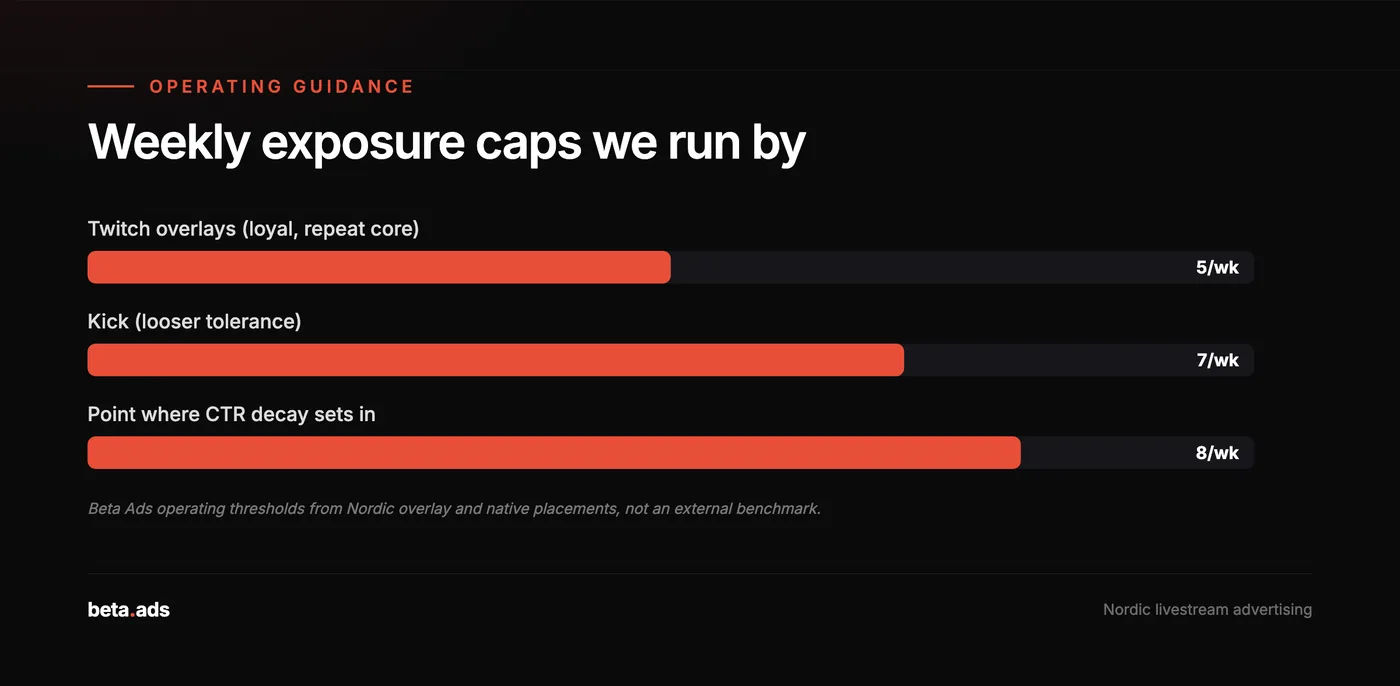
There is no universal number, but after running overlay and native placements across dozens of Norwegian and broader Nordic channels, a few thresholds hold up:
- 3 to 5 exposures per viewer per week is the safe zone for a single creative on an always-on placement (banner, corner bug, lower third).
- 6 to 8 exposures per week starts producing measurable click-through decay, usually a drop of 20 to 35 percent from week one to week two on the same creative.
- 10+ exposures per week is where chat sentiment turns, viewers start typing things like "again?" or muting overlays in extensions, and in the worst cases streamers get DMs asking to dial it back.
Native integrations (streamer reads, on-screen product callouts) tolerate less frequency than passive overlays because they interrupt attention rather than sitting alongside it. A streamer doing a live read of the same script three times in one broadcast is a different problem than an overlay looping quietly in a corner, and it should be capped separately in the media plan, not lumped into the same frequency bucket.
The three faces of creative wearout
Wearout does not always look like declining CTR. On stream, it shows up in three distinct ways, and campaigns need to watch for all three:
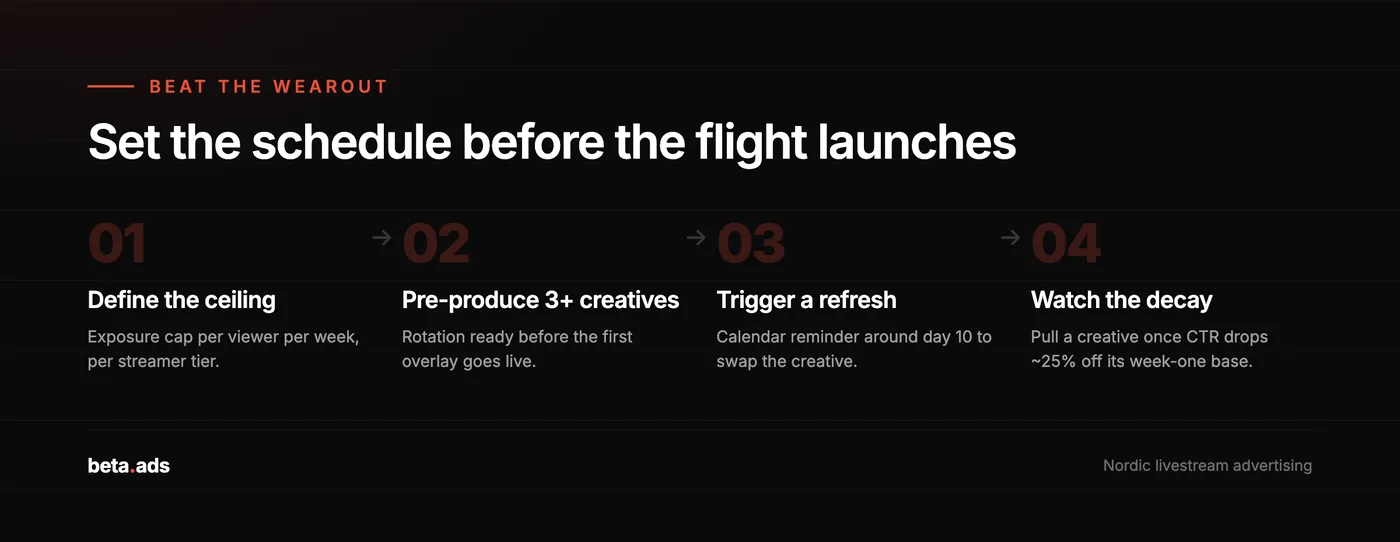
Performance wearout. Click-through and conversion pixels drop. This is the easiest to catch because it is in the dashboard. Once a creative's CTR falls more than roughly 25 percent from its first-week baseline, it is done, regardless of how much flight budget is left.
Attention wearout. Viewers stop looking at the overlay at all. Session-level engagement tools (like Beta Ads' Voice Recognition triggers, which fire based on what is actually being said on stream) can catch this before the click data does, because they measure whether the moment is landing, not just whether someone eventually clicked.
Community wearout. This is streaming-specific and it is the one brands underestimate. Because the audience is a community, not an anonymous impression pool, repeated creative becomes a running joke or a running complaint in chat. Once viewers start referencing the ad unprompted, unrelated to the product, the brand has crossed from "sponsor" to "bit," and that is a harder position to recover from than a CTR dip.
Setting frequency caps by platform
Twitch advertising and Kick advertising behave differently enough that a single global cap is a mistake.
On Twitch, audiences skew toward longer average session length and heavier repeat viewership from a smaller loyal core, so caps need to be tighter: 4 to 6 exposures per viewer per week for overlays, hard reset every 5 to 7 days with a creative swap. Twitch chat also has a longer institutional memory. A joke about an overlay from three weeks ago will resurface.
On Kick, the audience is younger, sessions are more anarchic, and channel-hopping is more common, which naturally dilutes frequency somewhat. Caps can run slightly looser, 6 to 8 exposures per week, but the tolerance for anything that looks like it is talking down to the audience is lower. Kick chat will call out a stale or corny creative faster than Twitch chat will.
Neither platform has a native frequency cap tool built for overlay sponsorships the way programmatic display does, so this has to be managed at the campaign planning level: rotation schedule, streamer count, and segment placement, not an ad server toggle.
How to rotate creative across a flight
A four-week flight is the most common structure we build for advertisers, and the rotation pattern that consistently holds attention looks like this:
Week 1: Introduction creative. Establish the product, the offer, the visual identity. This is where the brand can afford to be direct because nobody has seen it yet.
Week 2: Same core message, different execution. Same offer, different visual treatment or different streamer voice reading it. Do not touch the underlying value proposition, just the wrapper. This buys another week before wearout sets in without confusing the audience about what is being advertised.
Week 3: Angle shift. Pull a different benefit forward. If week one led with price, week three leads with product feature or social proof. This is also the point to rotate which streamers in the roster are carrying the heaviest placement load, since the streamers with the most loyal, high-frequency viewers are the ones whose audiences hit wearout first.
Week 4: Urgency or close. Scarcity, deadline, or last-call framing, paired with a creative that has not run before. Saving one unused execution for the final week consistently outperforms running the same three creatives on a loop for the full month.
For flights longer than four weeks, the rule of thumb is one new creative execution every 10 to 14 days minimum, and a full concept refresh (not just a palette or copy tweak) every 6 weeks. Brands that try to stretch a single hero creative across an 8-week flight almost always see the back half underperform the front half, even when total spend and placement count stay identical.
Building the cap into the media plan, not the post-mortem
The mistake we see most often is treating frequency and wearout as something to review after a flight ends. By the time a post-campaign report shows CTR decay in week three, that decay already cost the client money. The fix is to set the cap and rotation schedule before the flight launches: define exposure ceilings per streamer tier, pre-produce at least three creative executions before the first overlay goes live, and put a calendar trigger on day 10 to check early decay signals rather than waiting for the final report.
This is also where multi-streamer campaigns have a structural advantage over single-streamer deals. Spreading the same budget across six or eight channels instead of two naturally lowers per-viewer frequency, because no single viewer is watching every channel every night. It is one of the reasons roster-based buys tend to hold performance longer than concentrated ones, independent of the creative itself.
If you are planning a flight and want a rotation schedule built around your specific streamer roster and flight length, get in touch and we will map out the caps before the first overlay airs, not after the numbers come back soft.