
How to Measure Incremental Sales Lift From a Twitch Sponsorship
Impressions tell you who saw your Twitch campaign. Control groups, geo holdouts, promo codes, and brand-lift surveys tell you whether it actually sold anything.
Impressions are a receipt, not a result
A Twitch sponsorship deck full of impressions, average concurrent viewers, and hours watched will always look impressive. None of those numbers tell you whether the campaign moved product. A streamer with 8,000 average viewers running a three-hour integration can generate 400,000+ impressions without a single incremental sale, and a mid-tier streamer with 1,200 viewers running a tight promo-code segment can outsell them both. The only way to know which is which is to measure lift: the difference between what happened and what would have happened without the sponsorship.
This is the same discipline TV and radio buyers borrowed from pharma and CPG decades ago, adapted for a channel where you actually have the tools to do it properly. Twitch and Kick give you something linear broadcast never could: a real-time, geographically distributed, individually addressable audience. That means you can run a genuine test-and-control study on a single campaign, not just a brand tracker six weeks later.
Start with a hypothesis, not a hashtag
Before any of the methods below make sense, define what "lift" means for this specific campaign. Is it site visits within 48 hours of the stream. Is it promo-code redemptions. Is it app installs. Is it a measurable bump in branded search volume in the sponsor's home market. Pick one primary metric and two secondary ones before the stream airs, not after you've seen the data and gone looking for a story. Advertisers who skip this step end up p-hacking their own campaign report, cherry-picking whichever number moved.
Control and exposed groups: the cleanest read you'll get
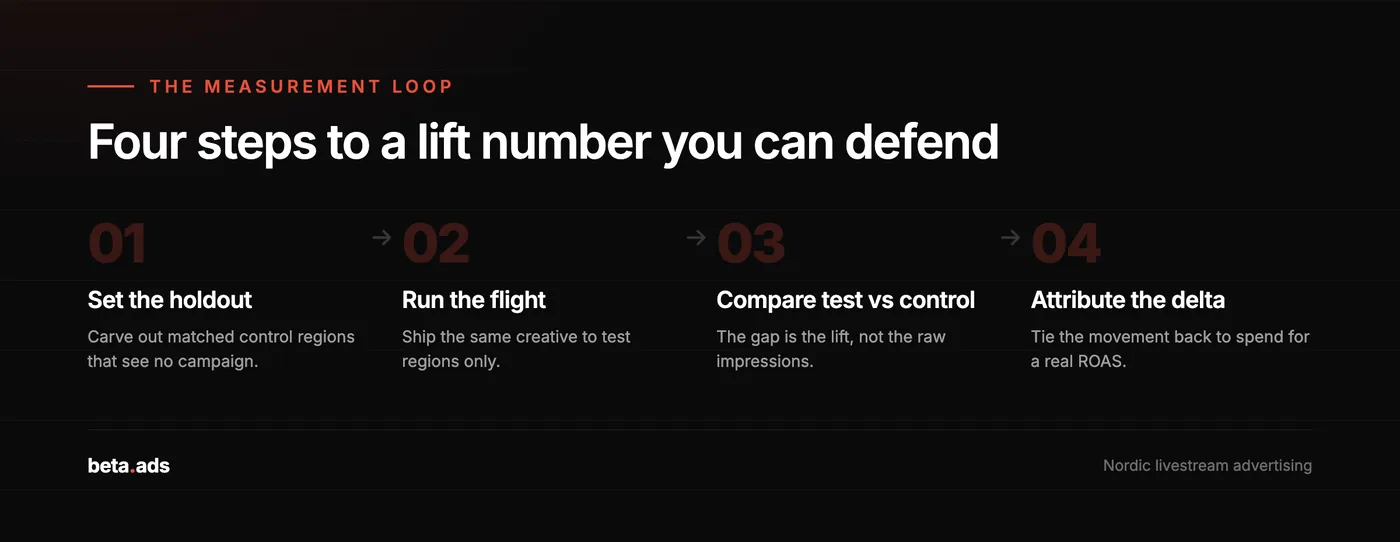
The gold standard is a matched control group: people who could have seen the stream but didn't, compared against people who did. On Twitch this is achievable a few ways.
The most reliable version uses the streamer's own audience data combined with the advertiser's first-party data. If the sponsor has a customer list or pixel-tracked site visitors, you can match Twitch viewer IDs (via the streamer's platform integrations or a clean-room match) against that list, then compare purchase behavior of matched-and-exposed users versus matched-but-unexposed users in the same demographic bucket. This requires cooperation from the streamer's team or a data partner and a signed data processing agreement, but it produces a lift number you can defend to a CFO.
A lighter-weight version works for advertisers without a mature first-party pixel: run the same creator, same script, same offer across two comparable audience segments, exposed at different times, and compare conversion in the hour after each exposure against a rolling baseline built from the prior four weeks of traffic at that same hour. It is noisier than a matched-panel design, but it is far better than trusting impressions alone, and it costs nothing beyond analyst time.
Geo holdouts: the blunt instrument that still works
When a campaign runs across multiple markets, geo holdouts are the fastest way to isolate causal lift without needing individual-level tracking. Pick two or three comparable regions, run the sponsorship-driven promotion in some and withhold it in others, then compare sales, site traffic, or app installs in the exposed regions against the holdout regions over the same window.
This works especially well for Nordic advertisers running Twitch campaigns targeted at Norway, Sweden, and Finland simultaneously. Hold Finland out of a given flight while Norway and Sweden get full exposure, then compare the delta in e-commerce conversion rate across all three against the prior four-week average. A clean geo holdout with even modest sample size, in the range of 15,000 to 40,000 weekly site sessions per region, will usually surface a lift signal if the true effect is anywhere above 3 to 4 percent, which is a realistic band for a well-executed integration.
The catch is contamination. Streamers have cross-border audiences, VPN usage blurs geo-targeting, and paid search or retargeting campaigns running in parallel can leak into your holdout region and wreck the comparison. Freeze all other marketing variables in the holdout market for the test window, or at minimum log them so you can control for them in the analysis.
Promo-code and link attribution: cheap, fast, and underused
The simplest lift signal available to any advertiser working with a streamer is a unique promo code or vanity URL tied to that specific creator and flight. This is not new, direct-response radio has used it for seventy years, but Twitch sponsorships routinely skip it in favor of vague "check the description" asks that generate weak redemption tracking.
The fix is specificity. Give the streamer a code that is short, easy to say on stream, and spelled out on an in-game or webcam overlay for the duration of the segment, not just dropped once in chat. Redemption rates vary enormously by category and creator authenticity, but a well-integrated code from a streamer with genuine product affinity typically lands in the 0.8 to 2.5 percent range of average concurrent viewers redeeming within 72 hours, with outliers well above that for gaming peripherals, energy drinks, and betting products where the audience match is tight.
Promo codes undercount true lift because plenty of viewers buy without using the code, so treat redemption numbers as a floor, not a ceiling, and pair them with a baseline comparison of overall conversion rate on the same product page in exposed versus non-exposed windows.
Brand-lift surveys: measuring what didn't convert yet
Sales attribution catches people ready to buy now. Most viewers of any sponsorship are not in that window, but the stream still shifted their awareness, consideration, or purchase intent. Brand-lift surveys catch that.
The standard setup pairs an exposed panel, viewers of the specific stream or VOD, against a control panel with similar demographics who did not watch, then asks both groups the same short battery: aided awareness, purchase consideration, and likelihood to recommend. Run this within a week of the stream while recall is still fresh. Sample sizes of 300 to 500 per cell are enough to detect a meaningful shift for most consumer categories, and a well-executed single-creator integration will often move aided awareness by 4 to 9 percentage points against control, with purchase consideration moving less but still measurably.
The methodological trap is self-selection: people who agree to take a survey about a stream they watched are more engaged than average, which inflates the exposed cell. Recruit both panels the same way, ideally through a third-party panel provider rather than in-stream polling, so the comparison stays clean.
For advertisers already running interactive formats, on-stream polls and voice-recognition triggered moments generate a built-in engagement signal that correlates with lift even before the formal survey comes back. A viewer who taps a poll option tied to the sponsor is a different data point than a passive viewer, and treating them identically in your lift model understates the effect of your best-performing segments.
Put it together into one number
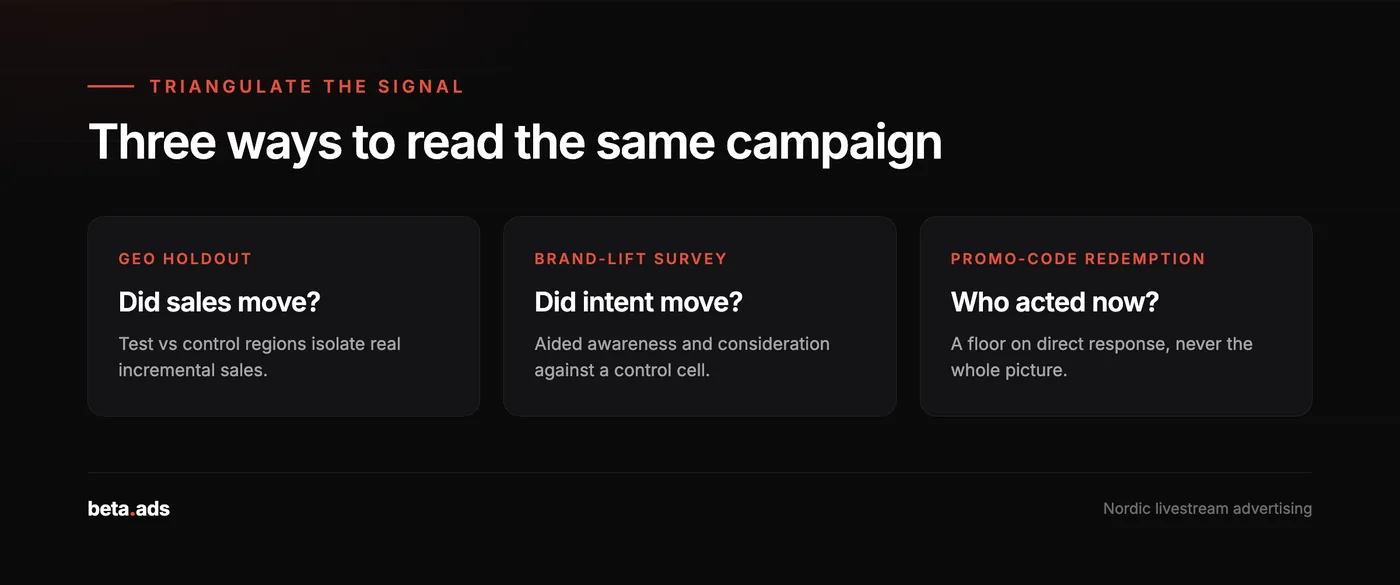
No single method above is sufficient on its own. Promo codes undercount, surveys measure intent rather than purchase, and geo holdouts get contaminated by cross-market bleed. The advertisers who get this right triangulate: a geo or panel-based control group for the topline sales lift number, promo-code redemption as a fast directional check within 72 hours, and a brand-lift survey to explain why the sales number moved the way it did. When all three point the same direction, you have a defensible number for the next budget conversation. When they diverge, that's usually a sign the creative or the offer needs work, not the measurement.
This is also why campaign reports built only on Twitch advertising impressions or Kick advertising delivery metrics undersell what these platforms can actually prove. The audience data and real-time exposure windows exist to build a real lift study, most advertisers just never ask for one.
If you want to see what a full lift methodology looks like against real budgets and real categories, our case studies walk through the control groups, the holdout regions, and the redemption numbers campaign by campaign. And if you are planning a flight and want the measurement plan built in from day one rather than bolted on afterward, get in touch before the stream date, not after.