
The Anatomy of a Creator Brief That Doesn't Kill the Read
What belongs in a native integration brief, what belongs to the streamer, and why over-scripting is the fastest way to turn a trusted creator voice into a flat ad read.
A creator brief is the single document most likely to determine whether a stream integration converts or gets muted out in a VOD. Most brands get it wrong in one of two directions: they send three bullet points and hope for the best, or they send a 12-page script with mandatory phrasing, timing cues, and a legal disclaimer read verbatim. Both fail, just on opposite ends of the spectrum.
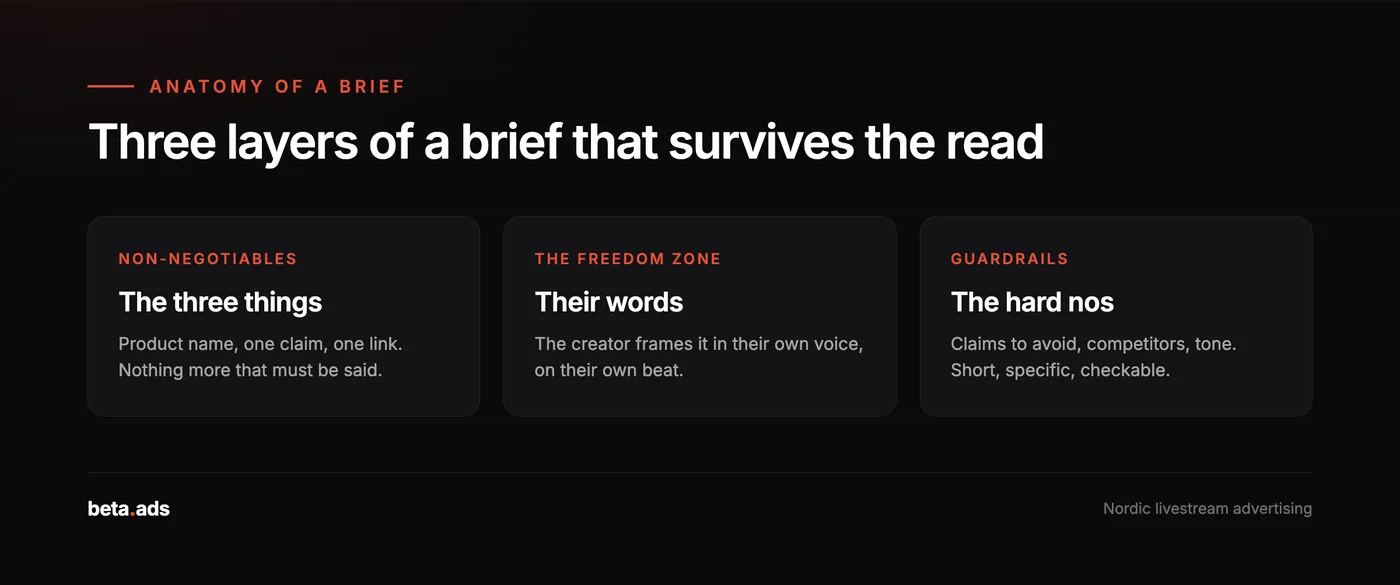
The good news is that the fix is not mysterious. A strong brief separates what must be true (the "spine") from how it gets said (the streamer's job). Get that split right and you get integrations that convert. Get it wrong and you get either chaos or the kind of dead-eyed ad read that makes chat spam "L" for two minutes straight.
What actually has to be locked down
Every brief needs a non-negotiable core. This is the part you own, because it protects the client and the campaign's measurability.
- The offer, exactly as it needs to appear. If the promo code is BETAADS20 for 20% off, that string cannot be paraphrased. Give it in text, not just verbally, so it can be pinned in chat or shown on an overlay.
- The claim boundaries. If the product is a supplement, the streamer cannot say it "cures" anything. If it's a betting product, age-gating and responsible gambling language are mandatory, not optional flavor text. Spell out the 2-3 things that cannot be said, not a vague "keep it compliant" note.
- The call to action mechanism. Link in bio, link in panel, QR code on screen, or a code typed in chat. Pick one primary mechanism per stream. Streamers juggling three different CTAs in one segment dilutes all of them.
- Placement window, not placement script. "Somewhere in the first 45 minutes of the VOD" or "during a natural break, not mid-clutch in ranked" is a placement window. It tells the streamer when it is safe and useful, without dictating the exact minute.
- Duration or format. A 60-90 second organic mention is different from a 5-minute sponsored segment with an on-screen panel. Say which one you bought.
- Legal and platform disclosure requirements. On twitch-advertising campaigns this usually means a verbal "this is sponsored by" or the built-in branded content tool. On kick-advertising the disclosure norms are looser but you should still specify what you require, because Kick does not enforce this the way Twitch's branded content flow does.
That is the spine. Everything on that list should be in writing, in the brief, not left to a Discord message the day before the stream.
What you leave to the streamer
Everything else is theirs. This is the part brand teams struggle to let go of, and it's exactly the part that determines whether viewers trust the read.
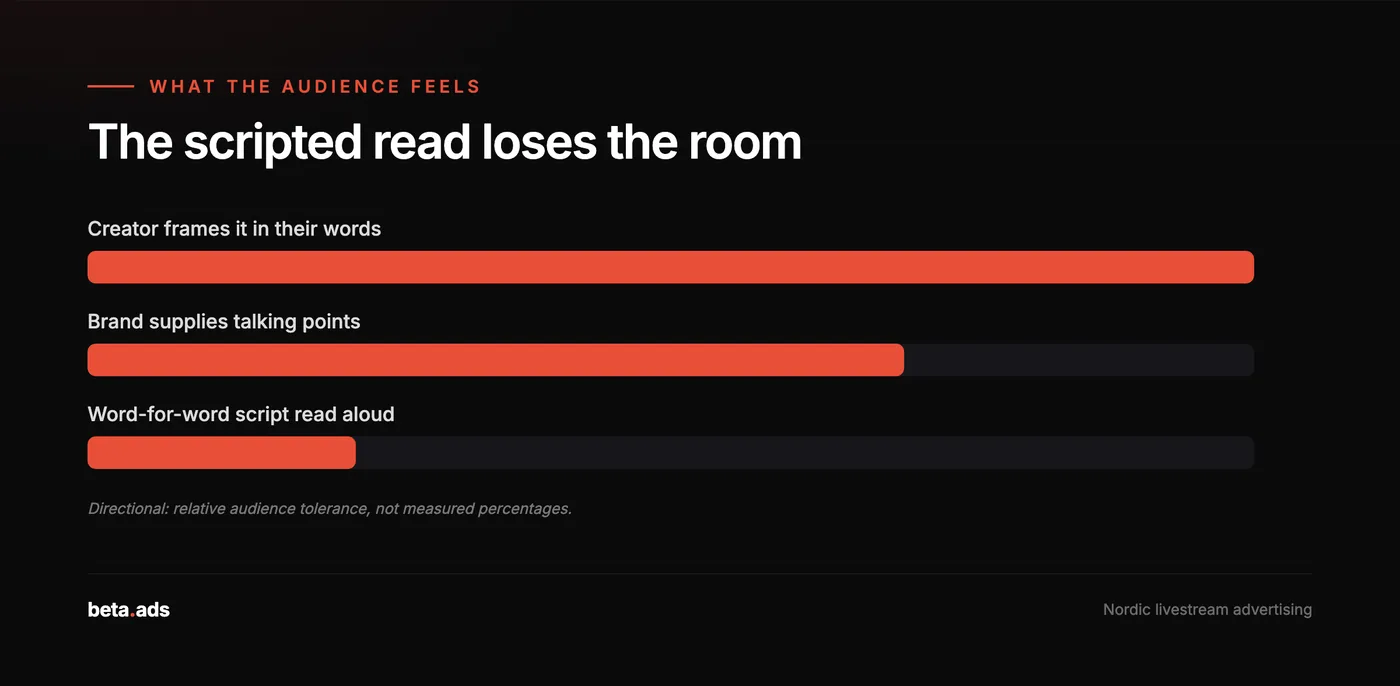
The wording. Give the three or four facts that need to land (a stat, a feature, the offer), not a script. A streamer who has said "grab your keys" or "let's get into it" four hundred times has a cadence. A brief that fights that cadence produces a read that sounds like it's being read off a card, because it is.
The timing within the window. If you gave a 45-minute window, let them find the natural break. Forcing a mention at "exactly 14 minutes in" ignores that streams are live and unpredictable: chat might be mid-raid, the streamer might be one kill away from a personal best, or there might be a technical issue. Rigid timestamps get either ignored or delivered at an objectively bad moment.
The framing device. Some streamers integrate a sponsor into banter with chat. Some do a straight, respectful pause-and-talk. Some tie it to what's happening in-game (a health-and-energy product mentioned right after a rough boss fight, for instance). This is craft, and it is the entire reason you hired a specific creator instead of buying a pre-roll ad.
Tone and humor. If a streamer's whole channel identity is deadpan sarcasm, do not brief them into enthusiastic hype-man copy. Mismatched tone is more damaging to brand trust than a slightly imperfect fact recall, because chat can smell inauthenticity within seconds and will say so, publicly, in the same chat log the sponsor can see.
The over-scripting problem, specifically
Over-scripting kills performance for three concrete reasons, not just a vague "authenticity" complaint.
First, memorization errors compound under live conditions. A streamer reciting a script from memory while also tracking chat, gameplay, and a raid alert will drop words, reorder sentences, or freeze. A dropped line in a scripted read looks like a mistake. A dropped line in a conversational integration is invisible, because there was no fixed line to drop.
Second, audiences pattern-match "read voice" almost instantly. Viewers who watch a creator for 40 hours a month know their real speaking rhythm. A shift into flatter, slower, more evenly-paced delivery is a tell, and it is one of the most common reasons viewers report tuning out or skipping ahead in a VOD during the sponsored segment.
Third, scripts can't adapt to the moment, and streams are never static. A script written on Tuesday for a Friday stream cannot account for what actually happens in chat, in-game, or in the news cycle by Friday. A brief built around beats, not lines, lets the creator fold the message into whatever is actually happening, which is what makes it feel native instead of interrupted.
A simple structure that works
A brief that fits on one page, organized in four sections, tends to outperform longer documents:
- The ask (spine items above: offer, code, claim limits, disclosure requirement)
- The window (when, how long, what format was purchased)
- The proof points (2-4 facts or features, in priority order, in case the streamer only has time for one)
- Examples, not scripts (link 1-2 past integrations, from this creator if possible, that hit the right tone)
That fourth section matters more than people think. Showing a streamer an actual clip of a good integration, ideally their own past work, communicates the target far better than paragraphs of adjectives like "authentic" and "natural." If you don't have their own past work, pull from case-studies and point to a comparable creator in a similar format.
Do's and don'ts, condensed
Do:
- Write the offer and code exactly as they must appear
- Give a placement window, not a placement minute
- Rank your proof points so the streamer can cut for time
- Attach an example clip
- Confirm disclosure requirements per platform
Don't:
- Write dialogue for the streamer to read verbatim
- Demand a specific joke, bit, or catchphrase be worked in
- Bury the actual offer in paragraph four of a long brief
- Assume chat won't notice a scripted tone shift, they always do
- Skip the claim boundaries and hope the streamer guesses correctly
The brief is a contract for outcomes, not for words
The best briefs read like a short spec sheet, not a shooting script. They tell the creator exactly what has to be true (the offer, the compliance boundaries, the window) and then get out of the way. The creator's voice, timing, and framing are the actual product you are buying when you book a native integration instead of a pre-roll. Scripting over that voice is like commissioning a portrait and then handing the painter a photograph to trace.
If you're building out a brief for an upcoming campaign and want a second pair of eyes on where the line should sit between spine and creative freedom, get in touch and we'll walk through a format that fits your platform mix and compliance needs.