
Who Owns the Clip? Usage Rights, Whitelisting, and the Paid Media Budget Brands Keep Leaving on the Table
Most brands treat a streamer integration as a one-off Twitch or Kick moment, then let the clip die on the channel. Here's what to put in the contract so that same footage can legally run as paid social and display.
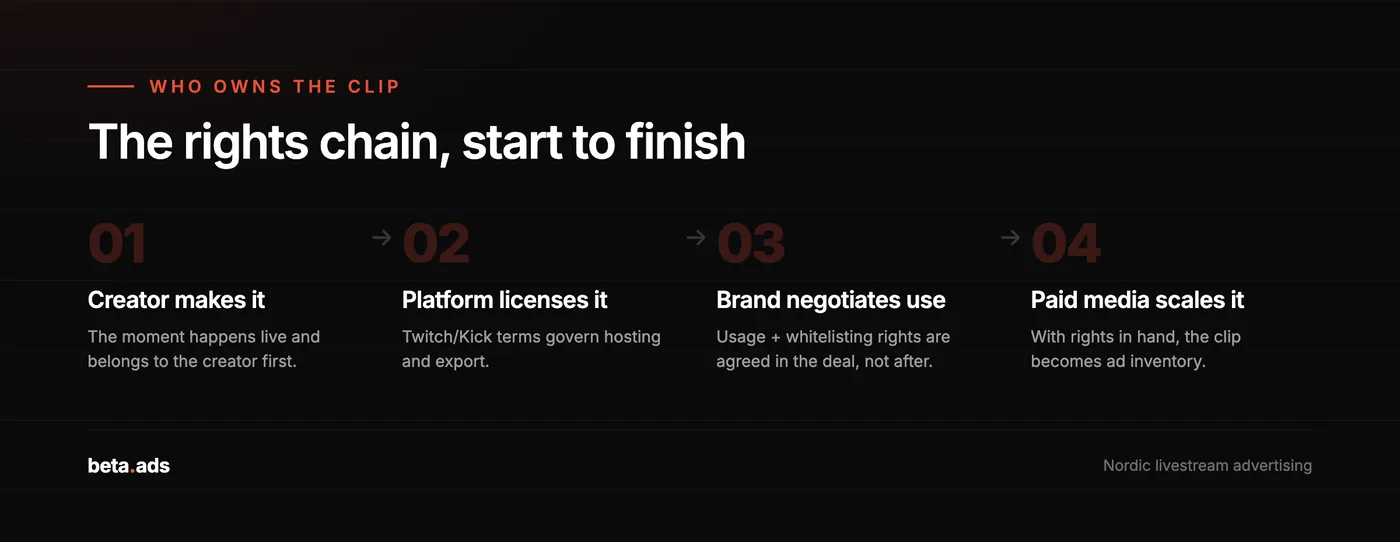
A brand pays a streamer for a 20-minute integration on Twitch. The segment goes well: a clean read, a genuine reaction, maybe a clip that gets reposted a few hundred times organically. Then the campaign ends, the invoice gets paid, and that footage never leaves the streamer's channel again.
That's not a legal problem. It's a contract problem. Without an explicit usage rights clause, the brand has no right to touch that footage, and most contracts in Nordic influencer and streaming deals still don't cover it. The result is that agencies and in-house teams pay full price for content creation, then pay full price again for a separate paid social shoot, when the clip they already own the relationship for could have done both jobs.
What "usage rights" actually means here
When a brand books a streamer, the default assumption under both Norwegian and general EU practice is narrow: the streamer created the content, the streamer owns the copyright, and the brand's payment covers the agreed placement (the stream itself, maybe a VOD) and nothing else. This mirrors standard influencer marketing law: a sponsorship fee buys a specific use, not a blanket license.
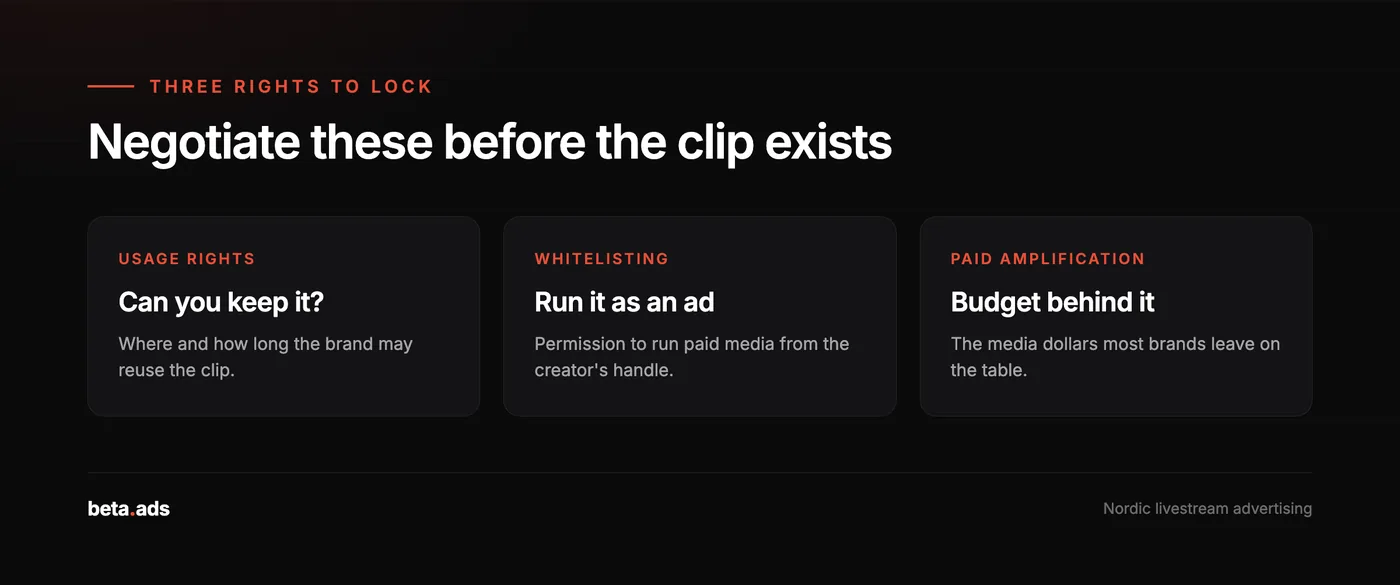
Usage rights (sometimes called content licensing or media rights in the contract) is the separate, additional right to take that footage and reuse it somewhere else, for a defined period, on defined channels. That could mean:
- Cutting the integration into a 15-second clip for Meta or TikTok paid ads
- Running the raw or lightly edited clip as a pre-roll or display creative
- Using a screenshot or still frame from the stream in a static display banner
- Featuring the clip on the brand's own YouTube channel or website as a testimonial-style asset
Whitelisting is the more specific cousin of this: the streamer gives the brand (or the brand's media buyer) permission to run paid ads directly through the streamer's own social handle. On Meta this is Partnership Ads; on TikTok it's Spark Ads. The ad appears to come from the creator's account, carries their engagement history, and typically outperforms the same creative posted from a branded handle because it reads as native content rather than an ad.
Both are licenses. Neither is included by default. Both need to be negotiated and priced before the stream happens, not requested afterward.
Why brands leave this value on the table
Three recurring reasons show up across the Nordic streaming and influencer market:
The media buying team and the influencer/streaming team don't talk. The person booking the Twitch integration is thinking about live reach and chat engagement. The person running paid social is thinking about CPMs and creative fatigue. Usage rights sit exactly in the gap between those two roles, so nobody owns the ask.
Brands assume payment equals ownership. It's a reasonable assumption if you're used to buying stock footage or commissioning an agency shoot, where a work-for-hire clause is standard. Streamer and creator content runs on the opposite default: the creator retains rights unless the contract says otherwise, similar to how a photographer retains copyright on commissioned photos unless it's explicitly bought out.
Negotiating usage rights after the stream is harder and more expensive. Once the clip exists and starts performing organically, the streamer (or their manager) has more leverage, not less. Asking for whitelisting rights after a clip has already hit 200,000 views is a very different negotiation than pricing it into the original deal.
What to actually put in the contract
A usage rights clause doesn't need to be complicated, but it does need to be specific. Vague language like "brand may use content for marketing purposes" gets disputed later because nobody agreed on what it meant. At minimum, spell out:
- Which platforms. Name them: Meta (Instagram/Facebook), TikTok, YouTube, programmatic display, the brand's own site. "Digital marketing" is not a platform.
- Paid vs. organic. Whitelisting/Partnership Ads access is a different right than reposting a clip organically on the brand's own channel, and should be priced separately.
- Duration. 30, 60, or 90 days is standard for a single campaign's paid usage window. Evergreen or perpetual usage costs meaningfully more and should be treated as a separate line item, not a rounding error.
- Territory. If the streamer has an international audience but the brand only wants Nordic paid reach, say so. It affects both the price and what the streamer is comfortable agreeing to.
- Edit rights. Can the brand cut, trim, add captions, add a logo bug or CTA end card? Streamers often care more about this than about the fee itself, because a bad edit reflects on their name.
- Approval step. A 24 to 48 hour review window before the brand publishes the cut is a normal, low-friction ask that avoids disputes later.
- Exclusivity, if relevant. If the brand wants the streamer to sit out competitor whitelisting during the same window, that needs its own clause and its own price.
On pricing: usage rights and whitelisting typically add anywhere from 50% to 150% on top of the base integration fee, depending on duration, platform spread, and whether it's organic reuse or full paid whitelisting access. A 90-day, multi-platform whitelisting license costs more than a 30-day, single-platform organic repost right, which is exactly why itemizing matters instead of asking for a flat "content usage" add-on.
Why it's worth the extra line item
The economics are straightforward once you compare it to the alternative. A branded studio shoot for a 15-second paid social ad, with a hired talent, a location, and post-production, runs into real production budget before a single impression is bought. A streamer clip that already has a natural, unscripted delivery and an existing audience relationship does the same creative job, often with stronger click-through performance because it doesn't look like an ad in the feed.
The catch is that this only works if the rights were secured up front. Trying to retrofit whitelisting onto a campaign that already ran, with a streamer who never agreed to it, either kills the option entirely or turns a cheap add-on into an expensive renegotiation.
For brands running integrations across Twitch advertising or Kick advertising, the practical move is to treat usage rights as a standard line item in every streamer contract template, not a special request reserved for your biggest campaigns. Even if a given campaign never ends up repurposing the clip, having the right already secured costs little and keeps the option open for 60 or 90 days after the stream airs, which is exactly when a strong organic clip is worth turning into paid media.
Making it standard practice
The fix isn't complicated. It's a checklist:
- Decide before booking whether this integration is a candidate for paid amplification
- Price usage rights and whitelisting as separate, named line items in the contract
- Specify platform, duration, territory, and edit rights explicitly
- Loop in whoever runs paid social before the contract is signed, not after the clip is live
- Build a standard clause into your streamer contract template so this isn't renegotiated from scratch every time
None of this requires new tooling or a bigger budget. It requires the contract to say, in plain terms, what happens to the footage after the stream ends.
If you're planning a streamer campaign and want to see how usage rights and whitelisting get structured in a real Nordic Twitch or Kick deal, take a look at our case studies or get in touch through our contact page. We're happy to walk through what a clause like this looks like for your specific campaign before you're locked into a contract that doesn't cover it.