
The 2026 Nordic Streaming Calendar: When to Book Twitch and Kick Campaigns in NO, SE, DK and FI
A month-by-month planning calendar for Nordic live-streaming media buys in 2026, mapped against esports events, game launches and seasonal viewing spikes across Norway, Sweden, Denmark and Finland.
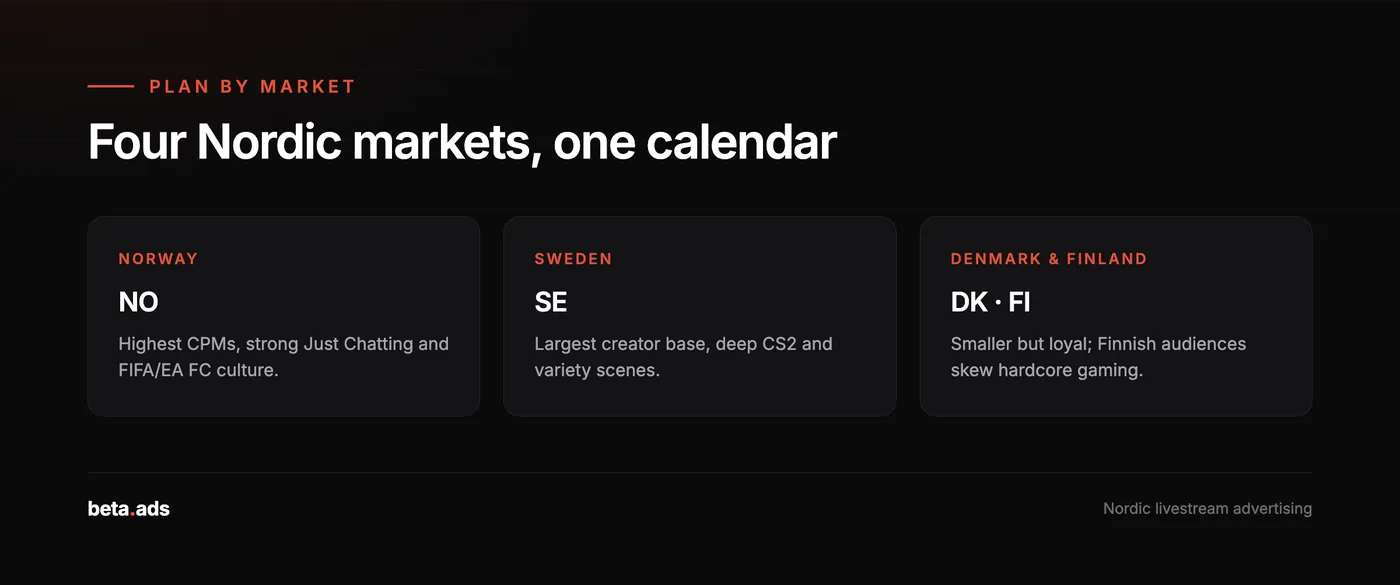
Most media plans for Twitch, YouTube and Kick get built the same way general TV or social plans get built: quarterly, in even blocks, with a vague nod to "gaming culture." That approach leaves reach on the table. Streaming audiences in the Nordics spike hard around specific events, then flatten. Booking flat, evenly-spaced flights ignores where the actual eyeballs are.
This calendar is built from how the Nordic streaming year actually moves: the esports calendar (CS2, League of Legends, Counter-Strike Major circuit), major game launches and content drops, and the seasonal rhythm of when NO/SE/DK/FI audiences are indoors and online versus outside and away from screens. Use it as a planning skeleton, then layer your specific client's category and audience on top.
Why month-by-month beats quarterly for streaming
A quarterly TV buy smooths naturally because linear inventory is roughly constant week to week. Streaming inventory is not. A single LAN final or a major patch launch can double concurrent viewership on a category for 72 hours, then it reverts. If your flight dates don't overlap those windows, you're buying the same CPM for a much thinner audience.
The other reason to plan monthly: production lead time. Custom overlay creative, streamer-integrated reads and co-branded segments need 2 to 4 weeks minimum with the streamer or platform to build properly. If you wait until the event is on your radar, you've already missed the production window.
Q1: January to March
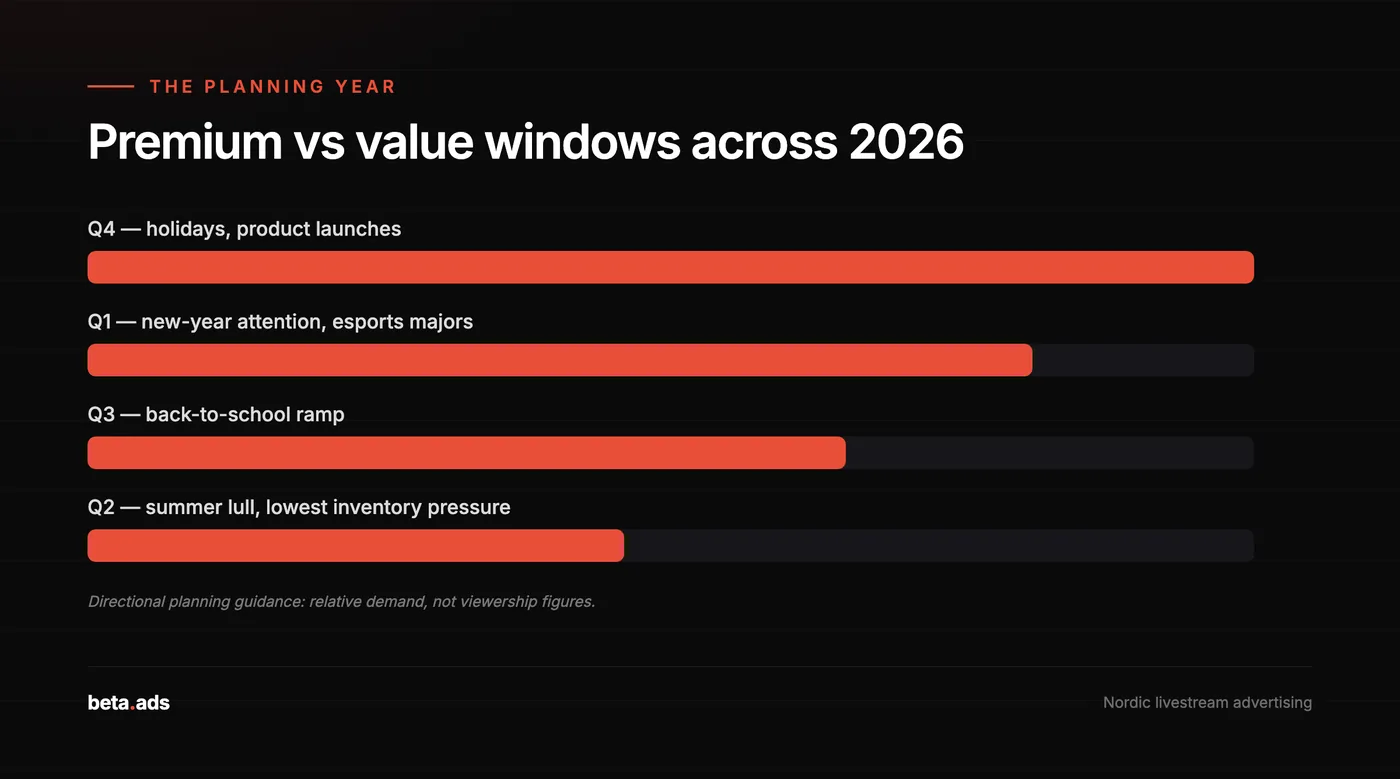
January is the quiet-strong month. Post-holiday, Nordic daylight is minimal, and indoor streaming consumption is at its yearly peak. This is a good low-competition month to book baseline always-on presence before other advertisers wake up from Q4 budget hangovers. PUBG, Counter-Strike and League of Legends viewership on Twitch and Kick both run high through the month with no major seasonal dip.
February typically carries the first big Counter-Strike or Valorant regional qualifiers of the year, plus the League of Legends European spring split kicking into its mid-season stretch. Finnish and Swedish CS2 talent draw strong domestic-language viewership on Kick specifically, which is worth knowing if your buy leans Kick over Twitch in FI/SE.
March is when major spring game releases start landing (varies by year, but historically a heavy month for AAA and live-service content drops). Watch release calendars closely here: a well-timed sponsored-moment overlay tied to a big launch week can ride a viewership curve you didn't have to create yourself.
Q2: April to June
April often includes the Masters-tier Counter-Strike events feeding into the Major cycle. If a Major or a Masters stop falls in this window, plan 3 to 4 weeks out: talent calendars fill fast once brackets are announced.
May is exam season across Nordic universities, which historically softens weekday daytime viewership among the 18 to 24 segment but strengthens evening and weekend viewing. Plan creative and flight timing around evenings rather than assuming flat daily delivery.
June brings the Midsummer stretch (Sankthansaften in Norway, Midsommar in Sweden, Juhannus in Finland, Sankt Hans in Denmark). This is the single clearest seasonal dip in the entire Nordic streaming year: outdoor gatherings pull audiences away from screens for roughly a week around the solstice. Do not schedule a flight launch here. If you have unavoidable June spend, front-load it into the first half of the month.
Q3: July to September
July is the deepest seasonal trough of the year. Summer holidays (fellesferie in Norway, semester in Sweden) empty out weekday viewership further than Midsummer does, for longer. This is the month to pause always-on budget and redirect it, not the month to launch anything new. If a client has fixed annual budget that must be spent, July dollars go further reallocated to August or January than spent at face value here.
August is the comeback month. Schools restart, daylight starts shortening again in the north, and viewership climbs back toward baseline through the second half of the month. This is also frequently when the autumn esports season announces its calendar, so it's a good month to lock talent and event sponsorships for Q4 before slots fill.
September typically carries a Major or significant international LAN in the Counter-Strike or League ecosystem, plus the start of new competitive splits. Back-to-school also means younger segments (16 to 20) return to more predictable weekday evening patterns, which is useful if your targeting skews younger.
Q4: October to December
October is historically one of the two strongest months of the year alongside January, combining shortening daylight, the League of Legends World Championship group stage, and a heavy AAA release corridor. If you only have budget for one aggressive Q4 push before December gets crowded and expensive, October is usually the better buy: same audience size as November/December, less competitive pressure on inventory and CPMs.
November brings League Worlds finals (viewership across NO/SE/DK/FI spikes hard around the final weekend) and the run-up to Black Friday, which pulls retail and e-commerce advertisers into the category hard. Expect inventory to tighten and CPMs to rise from mid-November onward. Book earlier in the month if budget allows.
December splits into two distinct halves. Weeks 1 to 3 are strong, gift-guide and holiday-campaign heavy, with elevated advertiser competition. The week of Christmas itself sees a sharp viewership drop as families gather and screens go dark, similar to Midsummer but longer. Plan flights to run hard through mid-December and go dark (or drop to minimal always-on) from December 22 through New Year's Day, then be ready to relaunch January 2.
Building this into an actual media plan
A few practical rules that come out of this pattern:
- Treat January and October as your two "quiet-strong" months: high viewership, comparatively lower competition for inventory than November or the weeks around a Major.
- Never anchor a flight launch to the week of Midsummer or Christmas week. Build a 5 to 7 day dark period into the plan instead of fighting for attention nobody has.
- Lock talent and custom integrations 3 to 4 weeks ahead of any confirmed Major, Masters event or Worlds stage, since that's when the best-fit streamers get booked out.
- Reserve some flexible budget for reactive buys around unannounced patch launches or surprise LAN announcements. The esports calendar shifts year to year, and rigid quarterly plans can't absorb that.
If you're planning Twitch or Kick specifically, the platform mechanics differ enough that flight structure should differ too. See our breakdowns on Twitch advertising and Kick advertising for format-level detail, and browse case studies for examples of how this kind of seasonal timing played out in real Nordic campaigns.
If you want a calendar built around your specific category, launch dates and markets rather than this general version, get in touch and we'll map it against your actual budget windows.