
Dentsu's 2025 Gaming Trends Report: What It Actually Means for Nordic Twitch Advertising
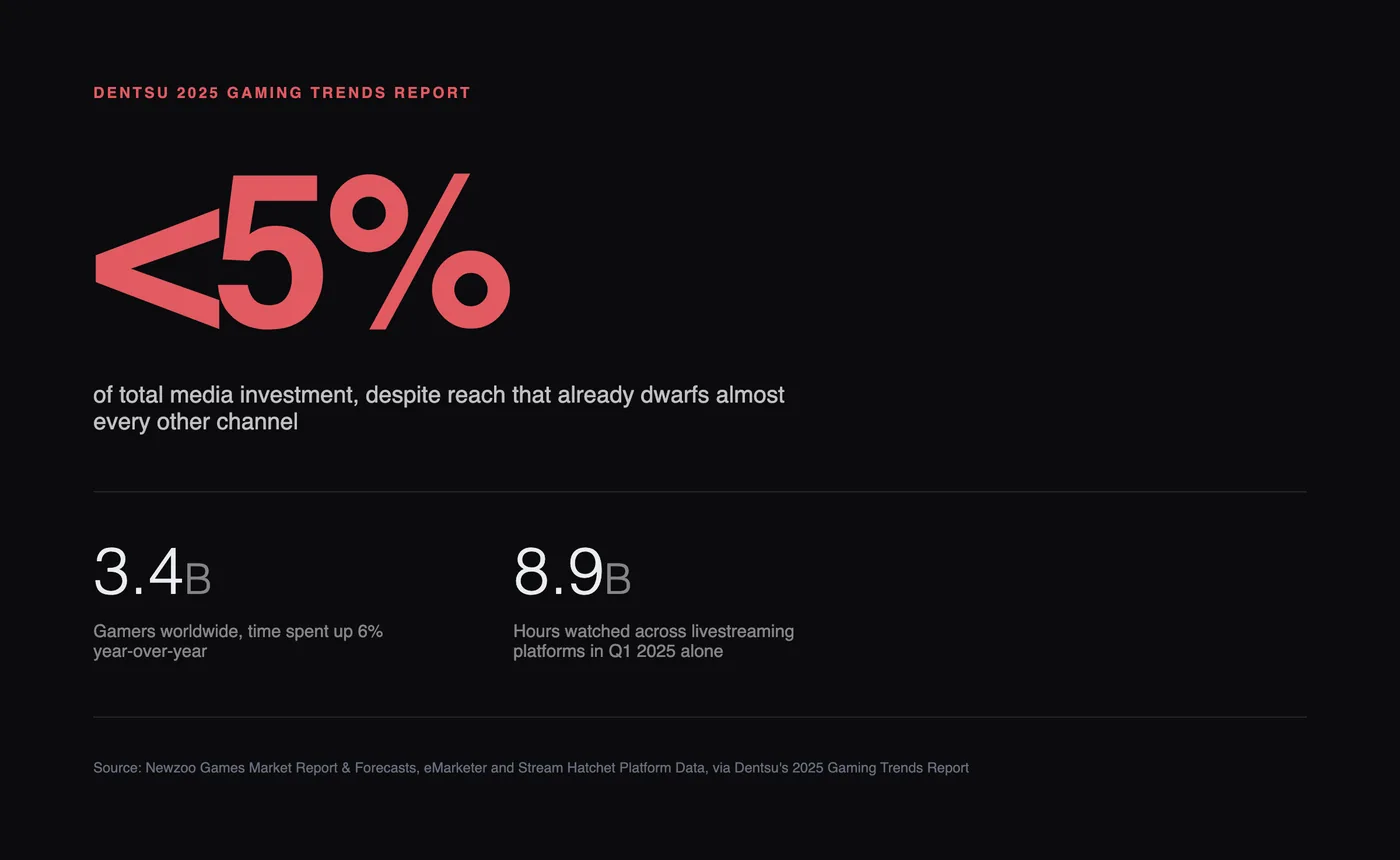
Dentsu's 2025 Gaming Trends Report puts real numbers behind what live-streaming advertisers have been arguing for years: gaming still gets under 5% of media budgets despite 3.4 billion players and 8.9 billion hours watched on livestreaming platforms in a single quarter. Here is what the report's actual data means for brands buying Twitch in the Nordics.
 TwitchYouTubeKick
A Global Report Just Confirmed What Twitch Media Buyers Already Suspected
Dentsu's 2025 Gaming Trends Report, built with data from Newzoo, GWI, Stream Hatchet, Twitch, Roblox, Discord, and Activision Blizzard Media, lays out a case that most media plans still have not caught up with: gaming is a full-funnel channel with the numbers to prove it, and most brands are still treating it as a side bet.
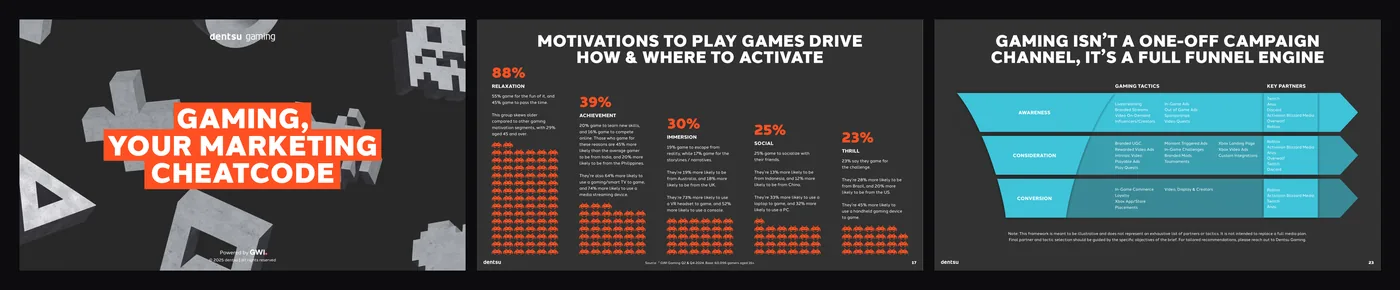
Browse the full report (PDF, 56 pages)
The headline figure is stark. There are 3.4 billion gamers worldwide, time spent in games grew 6% year-over-year, and yet gaming still captures less than 5% of total media investment, according to Newzoo's Games Market Report and eMarketer's US ad spending data cited in the report. That gap between attention and ad dollars is exactly the white space live stream advertising has been built to close.
The Livestreaming Numbers Are Bigger Than Most Media Plans Assume
Stream Hatchet's platform data, cited throughout the report, puts total hours watched across all livestreaming platforms at 8.9 billion in Q1 2025 alone. That is not a niche audience watching in the background. It is a primary entertainment habit with viewing patterns that map directly onto why people play in the first place.
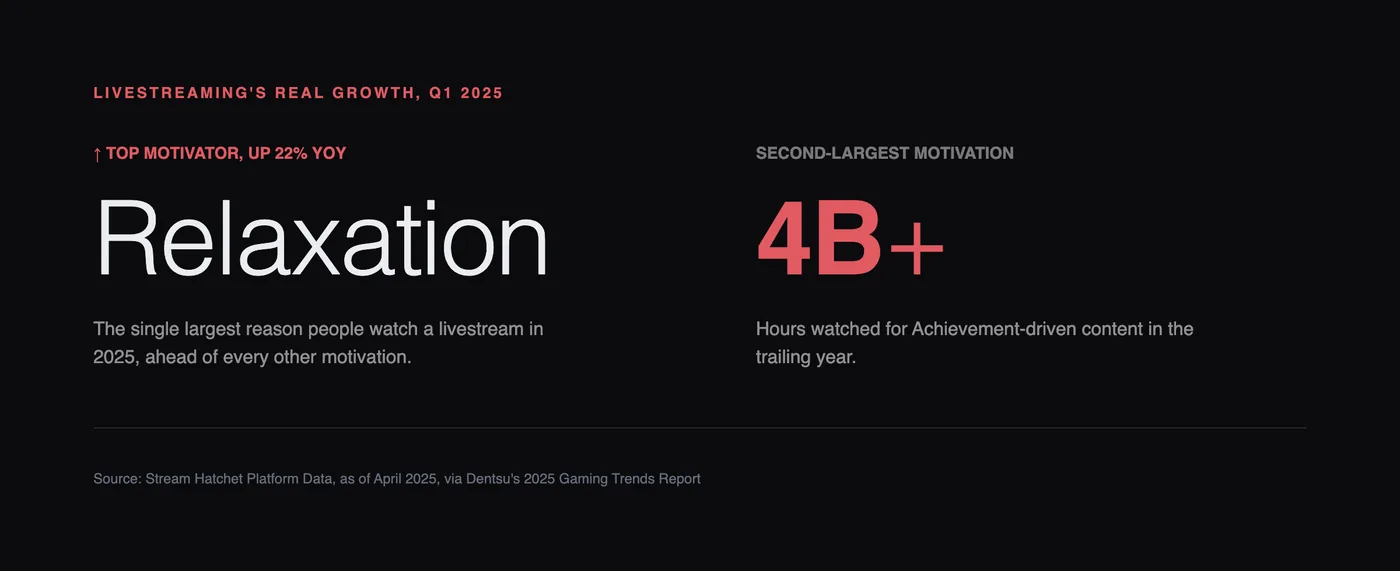
The report's breakdown of viewing motivations (also Stream Hatchet data, as of April 2025) shows Relaxation as the number one driver of viewership in 2025, up 22% year-over-year, with Achievement-driven viewing close behind at over 4 billion hours watched in the trailing year. Thrill-driven content ranks disproportionately higher in viewership than in actual play, meaning people watch competitive and high-stakes content even when they are not playing it themselves. For a media buyer, that is a signal about where attention concentrates on platforms like Twitch, and it argues against treating all stream inventory as interchangeable.
Why Viewers Actually Trust Streamer-Backed Brands
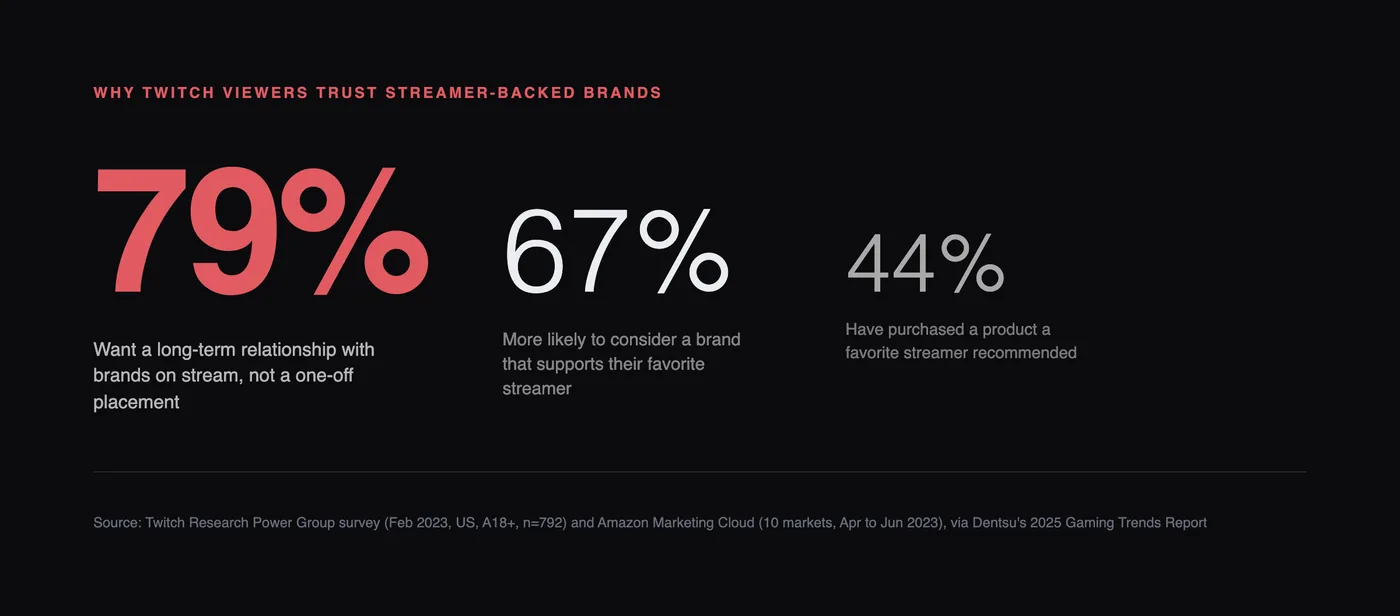
The part of the report most directly relevant to a Twitch-focused ad business is the trust data. Citing a Twitch Research Power Group survey (fielded February 2023, US, adults 18+, n=792), the report states that 44% of Twitch viewers have purchased a product because their favorite streamer recommended it. Separately, Amazon Marketing Cloud data covering ten markets (including several in Europe, fielded April to June 2023) found that 67% of viewers are more likely to consider a brand that supports their favorite streamer, and that 79% of Twitch's audience want a long-term relationship with the brands they see on stream, not a one-off placement.
That last figure matters more than it might look. It is a direct data point against the flat-fee, one-and-done sponsorship model that still dominates a lot of streamer marketing, and it lines up with what Beta Ads has seen in its own Nordic case studies: the campaigns that run longer, with real integration into the stream rather than a single read, are the ones brands keep coming back to.
Matching Ad Format to Why People Are Actually Watching
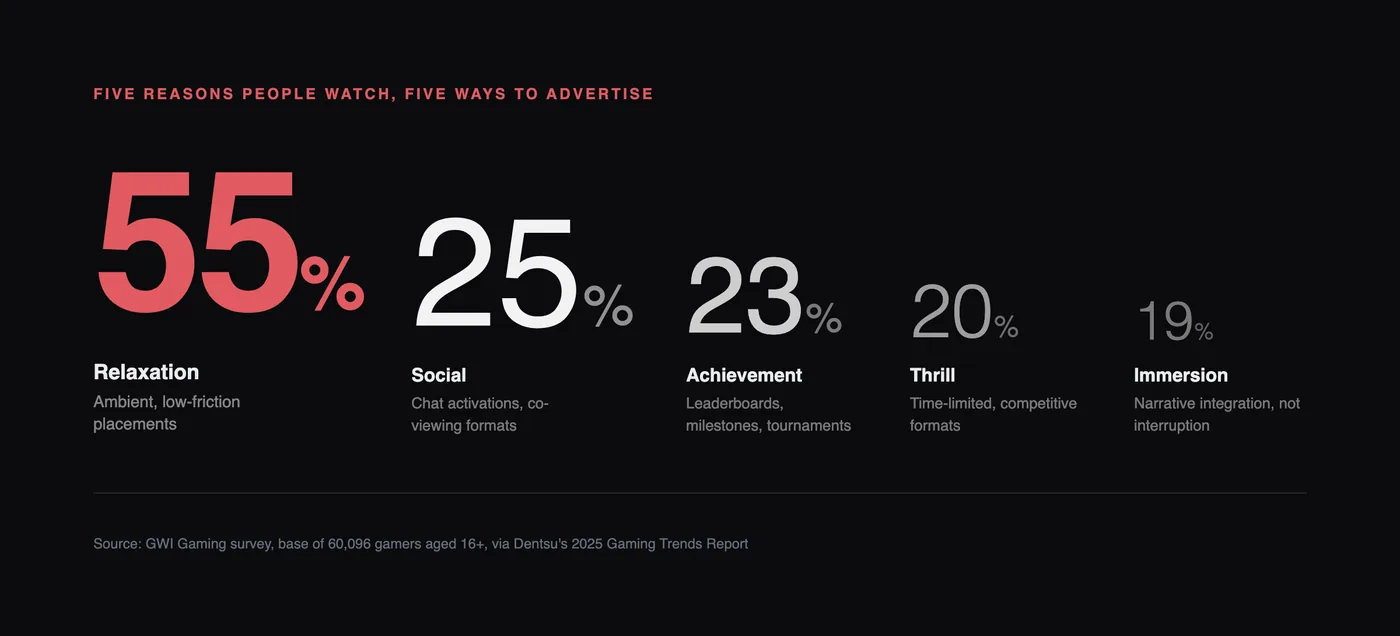
One of the more useful frameworks in the report groups players (and by extension, viewers) into five motivation types, based on GWI Gaming survey data from a base of over 60,000 gamers aged 16+: Relaxation, Achievement, Immersion, Social, and Thrill. Each motivation implies a different kind of ad format:
- Relaxation-driven audiences respond to low-friction, ambient placements rather than anything that demands active attention.
- Achievement-driven audiences respond well to progression-based mechanics: leaderboards, milestone rewards, tournament sponsorships.
- Immersion-driven audiences want narrative integration, not interruption.
- Social-driven audiences engage with anything built around community participation, from chat-based activations to co-viewing formats.
- Thrill-driven audiences respond to time-limited, competitive formats.
This is the argument for native and overlay formats over generic pre-roll: a single static ad unit cannot serve five different motivations at once, but an overlay that adapts to context, timed to what is actually happening on stream, can.
Two Campaigns From the Report Worth Studying
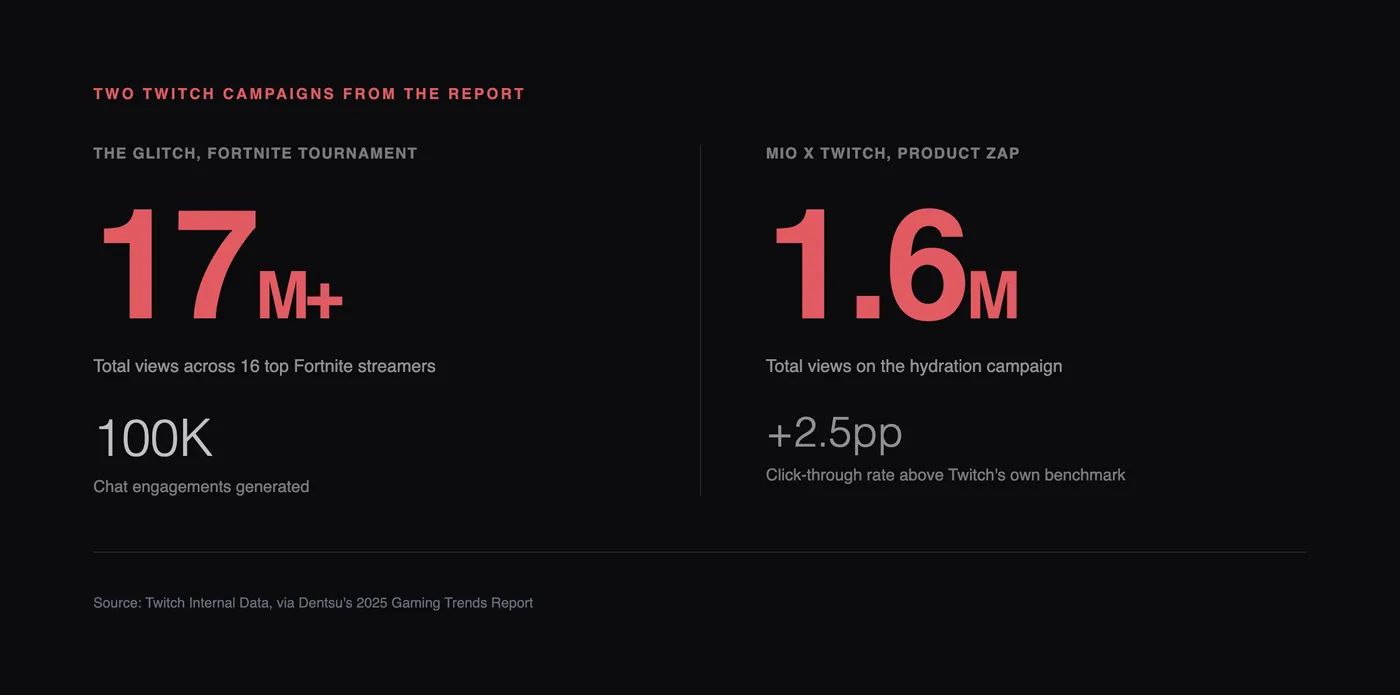
The report includes two Twitch-specific case studies worth noting for anyone planning a livestream campaign, both drawn from Twitch's own internal data.
"The Glitch," an influencer tournament format bringing together 16 top Fortnite streamers, generated over 17 million total views and 100,000 chat engagements. It is a useful reference point for how much reach a well-structured multi-streamer tournament can generate relative to a single-creator sponsorship.
A campaign for the hydration brand Mio used Twitch's Product Zap extension to turn viewer chat commands into an in-stream mini-game, driving 1.6 million total views and a click-through rate 2.5 percentage points above Twitch's own internal benchmark. The mechanic did not interrupt the stream. It ran inside it, which is precisely the design principle behind native overlay advertising on Kick and Twitch.
What This Means for Nordic Brands
The report's data is global, and none of it is Nordic-specific. That distinction matters, because the temptation is to assume Scandinavian, Danish, Norwegian, and Finnish audiences behave identically to the US and global respondents surveyed by GWI and Twitch's research team. They do not always, and Nordic-specific behavior is exactly what a regional partner needs to bring to the table.
What does translate directly is the underlying argument: media investment in gaming and livestreaming has not caught up with where attention already is, viewers reward brands that show up as part of the stream rather than an interruption to it, and format choice should follow why people are watching, not just how many of them there are. Beta Ads' own campaigns, from Samsung's Galaxy Z Fold7 launch on Norwegian Twitch to Shure's MV6 campaign, which ran at a 9.12% CTR, were built on the same principle the Dentsu report lands on with global data: native, in-stream formats outperform anything that asks the viewer to look away from what they are already watching.
If your 2026 media plan still treats livestreaming as a test line item rather than a full-funnel channel, the gap between attention and investment that this report documents is exactly the opportunity. Talk to Beta Ads about what that looks like for your brand in the Nordic market specifically, not just the global average.